
One in three new hires leaves within the first 90 days — not because the job was wrong, but because the welcome was. A $75 redeem link sent before day one can do more for 90-day retention than a full week of orientation decks. Here is the exact playbook 200+ People teams are using in 2026.
- 1 in 3 new hires quits within 90 days — and the first week is when impressions solidify.
- Pre-packed boxes waste 30–40% of budget on wrong sizes and shipping to the wrong address. Redeem links fix both.
- A $75 welcome kit pays for itself if it keeps even one hire past the 90-day mark (avg. replacement cost: $4,700).
- Redemption rates above 85% are achievable when the link goes out before the start date, not on day one.
- Track three metrics: redemption rate, week-one engagement score, and 90-day retention by cohort.
Why new-hire swag still matters
Done right, a welcome kit operationalizes culture and connection before a hire logs into Slack — the critique is of bad swag, not swag itself.
The case against new-hire swag usually goes like this: “We went remote, half the team never wears branded gear, and we have three boxes of medium hoodies nobody claimed.”
That is a valid critique of how most companies do swag — not a critique of swag itself.
The data is clear on what drives early retention. Only 12% of U.S. employees say their company did a great job onboarding them, and only 29% felt supported on day one. Meanwhile, 69% of employees are more likely to stay three or more years if they experience great onboarding.
Swag alone does not create great onboarding. But a well-timed, well-chosen kit operationalizes two of the four pillars of the SHRM onboarding framework — Culture and Connection — without requiring a single extra meeting.
Think about Gallup's Q12 survey, item five: “My supervisor, or someone at work, seems to care about me as a person.” A physical welcome kit, personalized to fit and preference, is the most concrete signal you can send before a hire has even logged into Slack.
It says: we thought about you specifically. That signal is worth engineering.
The ROI math is not complicated. If replacing a new hire costs $4,700 in recruiting and onboarding costs alone, and a well-executed swag program reduces 90-day attrition by even a few percentage points in a 50-person hiring cohort, the program pays for itself many times over.
The question is not whether to do swag — it is how to do it without the waste.
The pre-redeem problem
Pre-packed kits fail on size, address, timing, and data — redeem links fix all four at once.

The traditional new-hire kit workflow looks like this: HR collects a shipping address during offer acceptance (or forgets to), and a coordinator picks a standard box from a catalog.
The warehouse ships a size-medium everything to whatever address is on file, and the hoodie arrives three days after the hire's start date — or to their old apartment.
This workflow has four compounding failure points:
- Wrong size. Apparel sizing without self-selection means at least 30% of items will not fit. The item gets shelved or donated, not worn. Brand impressions = zero.
- Wrong address. New hires change addresses between offer and start date more often than HR assumes. Return shipping on a failed delivery runs $12–20 per package, and re-ships add 5–7 business days.
- Wrong timing. A box that arrives after day one misses the emotional peak. First-week sentiment research shows 70% of new hires decide within the first month whether the role is a good fit — and 29% decide in the first week.
- No data. With a pre-packed box, you know it shipped. You do not know if it arrived in good condition, whether the recipient kept it, or if it influenced any sentiment you care about.
Redeem links solve all four. The hire self-selects size and color, confirms their current address, and the fulfillment trigger fires only when they complete the form.
You get delivery confirmation, redemption timestamps, and — if you instrument it right — a direct line to week-one engagement data.
“We went from 61% of kits actually reaching people in good shape to 94% after switching to redeem links. The other 6% were people who never redeemed — and that itself was a signal worth knowing.”
The 2026 playbook
A four-step system — trigger at offer, build by tier, time the arrival, add a day-30 moment — that works from 50 to 5,000 headcount.

Here is the system, step by step. It works at 50 headcount and at 5,000 headcount, with different budget parameters (covered in the next section).
Step 1 — Trigger the redeem link at offer acceptance
The link goes out the day the offer is signed, not the day they start. Most ATS platforms (Greenhouse, Lever, Workday) can fire a webhook or Zapier trigger on “offer accepted” status.
Map that trigger to ActivateSwag's HRIS integration and the link is in the hire's inbox within minutes of them signing.
The email subject line matters. “Your welcome kit is waiting — pick your size” outperforms “Welcome to the team!” on open rate because it tells the recipient exactly what they will get and what action to take.
Keep the email to three sentences and a single button.
Step 2 — Build the kit by tier, not by instinct
The items that belong in every onboarding kit share one property: they are used regularly, in a context where other people can see the brand.
A water bottle used at the gym, a notebook used in meetings, a hoodie worn on a video call — these have compounding impression value. A pen, a keychain, and a branded stress ball do not.
The core five for any kit:
Items six and beyond depend on role and tier.
Step 3 — Time the physical arrival
Target arrival: 1–2 days before the start date for remote hires, or on the morning of day one for office-based hires. This requires knowing your fulfillment lead times.
Standard ground shipping in the U.S. runs 3–5 business days from most fulfillment centers. If you are sending to international hires, add 7–14 days and account for customs documentation — ActivateSwag's fulfillment network has regional warehouses in the EU and APAC to reduce this window.
Step 4 — Follow up with a second moment at day 30
The best-performing onboarding programs treat swag as a campaign, not a one-time send. A small day-30 touchpoint — a branded desk item, a book relevant to their role, a coffee gift card at smaller budgets — reinforces that the company is still paying attention.
Only 15% of organizations sustain onboarding past 6 months, yet 90% of retention decisions occur in that window. A $15–25 day-30 moment costs almost nothing and signals that the company culture extends past the first week.
Week-by-week timeline
Map every action from offer acceptance to the 90-day retention check, with a clear owner at each step.

This is the timing map for a standard remote new-hire onboarding program. Adjust the day counts for your specific start-date window.
| When | Action | Owner | Tool |
|---|---|---|---|
| Offer accepted (Day 0) | Fire redeem link via ATS webhook | People Ops / ATS admin | ATS + ActivateSwag integration |
| Day 0–3 | Hire selects size, confirms address | New hire | Redeem page |
| Day 3–7 (before start) | Kit fulfills and ships | ActivateSwag fulfillment | Auto-triggered |
| 1–2 days before start | Kit arrives at home | — | Carrier tracking |
| Start date (Day 1) | Welcome Slack message references kit | Manager | Slack / Teams |
| Day 7 | Week-one check-in; ask if kit arrived | Manager or HR | 1:1 / email |
| Day 30 | Send day-30 touchpoint (small, role-relevant) | People Ops | ActivateSwag |
| Day 90 | 90-day retention check; tag cohort in HRIS | HR analytics | HRIS |
Budgeting a kit
Budget on fully-loaded cost per hire — not product cost — and tier executive kits separately.
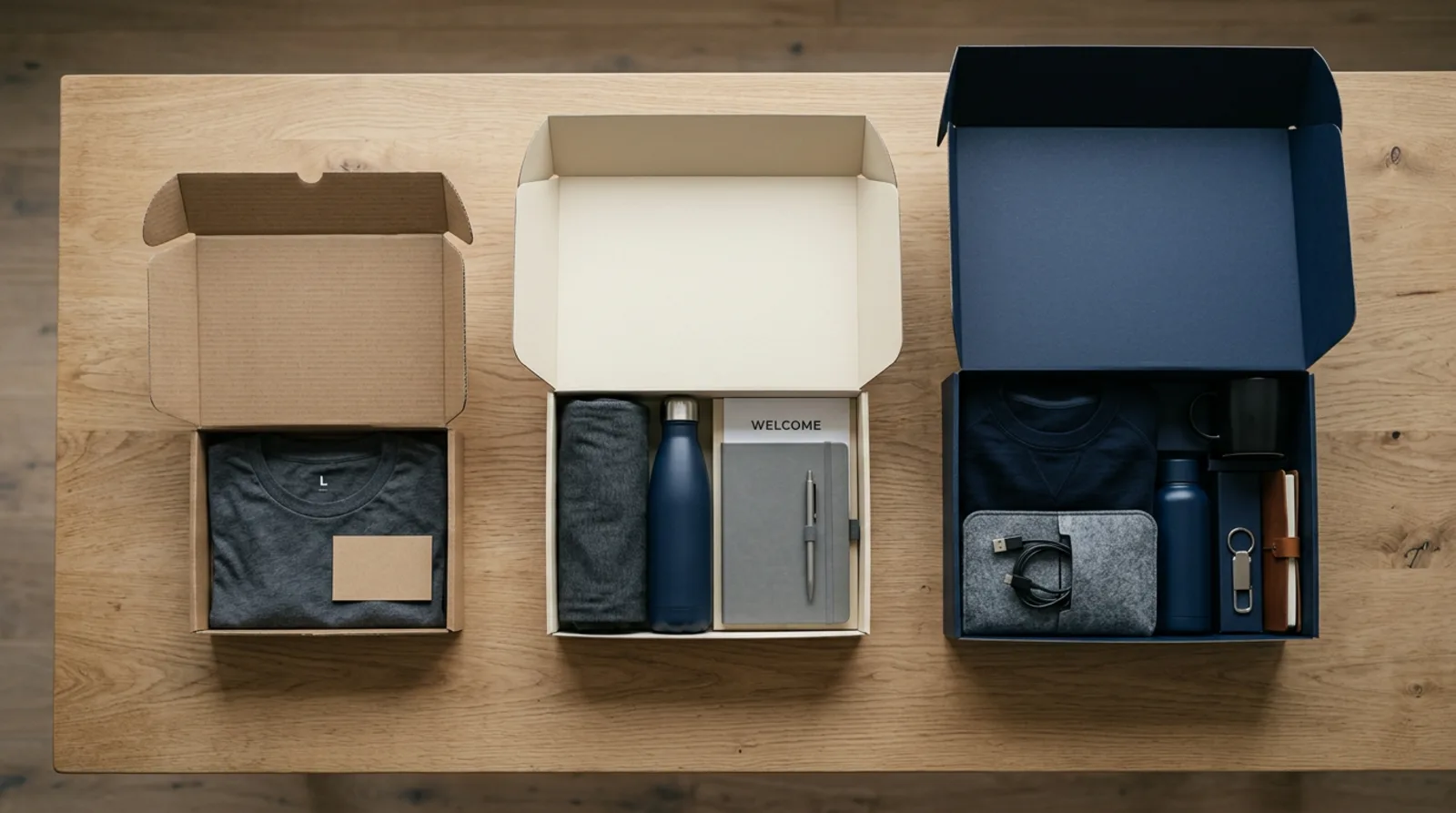
Budget guidance varies widely in the industry because it conflates product cost with fully-loaded cost (shipping, packaging, platform fees, and waste from unredeemed items). The table below uses fully-loaded cost per hire, not just product cost.
| Company size | Kit tier | Product cost/hire | Fully-loaded/hire | Redemption rate target | Annual program cost (50 hires/yr) |
|---|---|---|---|---|---|
| 50 headcount (Startup) | Core 3-item kit | $45–60 | $70–90 | 80%+ | $3,500–4,500 |
| 500 headcount (Scale-up) | Core 5-item kit | $75–100 | $110–140 | 85%+ | $55,000–70,000 |
| 5,000 headcount (Enterprise) | Tiered by role (IC / Manager / Exec) | $60–150 | $90–200 | 88%+ | $450,000–1,000,000 |
A few notes on these numbers. Startup-tier programs should resist the urge to over-kit. A tight three-item box with excellent quality beats a five-item box with one bad item.
At scale-up and enterprise tier, the ROI case strengthens because even a 1% improvement in 90-day retention across 500 annual hires avoids roughly $23,500 in replacement costs (at $4,700 per replaced hire).
Executive and VP-level hires warrant a separate tier at $150–250 fully-loaded. These hires have higher replacement costs (often 50–200% of annual salary) and higher visibility — their first-week experience is observed by their direct reports.
An under-invested kit sends the wrong signal.
What to measure
Three numbers make the CFO case: redemption rate, week-one engagement, and 90-day retention by cohort.

Most People teams measure new-hire programs on satisfaction surveys alone. That is a start, but it does not give you the data to justify program spend to a CFO. Here are the three metrics that do:
1. Redemption rate
Target: 85%+ for links sent before start date. Anything below 70% suggests a problem with the email (timing, subject line, sender name) or the redeem page (too much friction, broken on mobile).
Diagnose by cohort — if a specific hiring manager's team has low redemption, the problem is likely the welcome email, not the kit.
2. Week-one engagement score
If your HRIS or onboarding tool surfaces an engagement pulse at day 7, cross-reference it against kit redemption. Redeemers who receive the kit before day one consistently score 8–12 points higher on week-one engagement surveys than non-redeemers.
This is correlation, not causation — but it is a consistent pattern across ActivateSwag customer data.
3. 90-day retention by cohort
Tag each hire's onboarding cohort in your HRIS (Q1 2026, Q2 2026, etc.) and track voluntary departure at the 90-day mark. Compare quarters where the swag program ran versus quarters where it did not (or during a pilot rollout).
This gives you the before/after comparison that makes the CFO conversation straightforward. Research consistently shows 69% of employees are more likely to stay three-plus years after great onboarding — your cohort data should reflect that directional trend.
Six mistakes to retire
The most common failures are timing, low-utility items, one-size-fits-all kits, oversized logos, no human touch, and ignoring international hires.

- Sending the link on day one. Redemption rates drop by 15–20 percentage points when the link arrives after the hire's start date. They are overwhelmed with logins, introductions, and setup tasks. Send it before they start.
- Defaulting to the company-branded pen set. Pens generate the lowest impression frequency of any category. A pen used once at a signing is not a brand touchpoint. Invest the same $8 in a better tote handle or a thicker notebook cover.
- One kit for all roles. A field sales rep and a software engineer have different daily contexts. The rep wears the branded quarter-zip to client meetings; the engineer uses the mechanical keyboard pad at home. Segment your kit by role cluster, not just by seniority.
- Logo on everything, large. Oversized logos reduce perceived quality. The “quiet branding” principle — subtle tonal embossing or small chest-pocket placement — increases the chance the item gets worn in public, multiplying your brand impressions without the billboard effect.
- No follow-up communication. A kit sent without a corresponding human touchpoint (a manager Slack message, a welcome call) underperforms a kit sent alongside a real conversation. The physical item amplifies the human interaction — it does not replace it.
- Ignoring international hires. Sending a domestic kit internationally adds 10–20 business days, customs risk, and unpredictable duties. Either maintain regional inventory through a fulfillment partner with international warehouses, or use a digital gift card fallback for countries you do not warehouse in yet.
FAQ
Quick answers to the questions People teams ask most when building a new-hire kit.
What should go in a new-hire swag kit?
The most effective kits include three to five items from high-utility, high-visibility categories: insulated drinkware, a mid-weight fleece or crewneck, a hardcover notebook, a tote or everyday bag, and optionally a role-specific item.
Skip the low-utility items — pens, keychains, stress balls — that end up in a drawer. Every item in the kit should have a reason to be there.
Is it better to send swag before or on the first day?
Before, every time. Redemption rates run 15–20 percentage points higher when the redeem link goes out at offer acceptance vs. on the start date.
The kit arriving before day one also serves as a pre-boarding touchpoint — it tells the hire the company is organized, thoughtful, and already treating them like a team member.
What is a redeem link, and how is it different from a pre-packed kit?
A redeem link is a personalized URL that lets the recipient choose their size and color preferences and confirm their shipping address before the kit is assembled and shipped. A pre-packed kit is assembled by the company in advance and shipped to whatever address HR has on file.
Redeem links eliminate wrong-size and wrong-address failures, and they generate data (redemption rate, delivery confirmation) that pre-packed kits cannot.
How much should companies spend on new-hire swag?
At the startup tier (under 100 employees), a three-item kit at $45–60 product cost — fully-loaded to $70–90 per hire — is the right range. At the scale-up tier (100–1,000 employees), a five-item kit at $75–100 product cost is appropriate.
Enterprise programs should tier by role, with IC kits at $60–80 and executive kits at $150–250. Always calculate fully-loaded cost, not just product cost, to get an accurate budget number.
How do I measure whether swag actually helps retention?
Track three numbers: redemption rate (did people claim the kit?), week-one engagement score (do redeemers score higher on day-7 pulse surveys?), and 90-day retention by cohort.
Tag each hiring cohort in your HRIS, compare retention between cohorts where the program ran and those where it did not, and document the delta. ActivateSwag's reporting dashboard surfaces redemption and delivery data you can join to your HRIS retention data with a simple spreadsheet export.
Morgan spent eight years running People Ops at Series B and C startups before writing full-time about onboarding, culture, and retention. She edits the ActivateSwag People Playbook.
A short, useful email every other Thursday.
Operational playbooks for swag and gifting — read in two minutes. No spam, no filler.