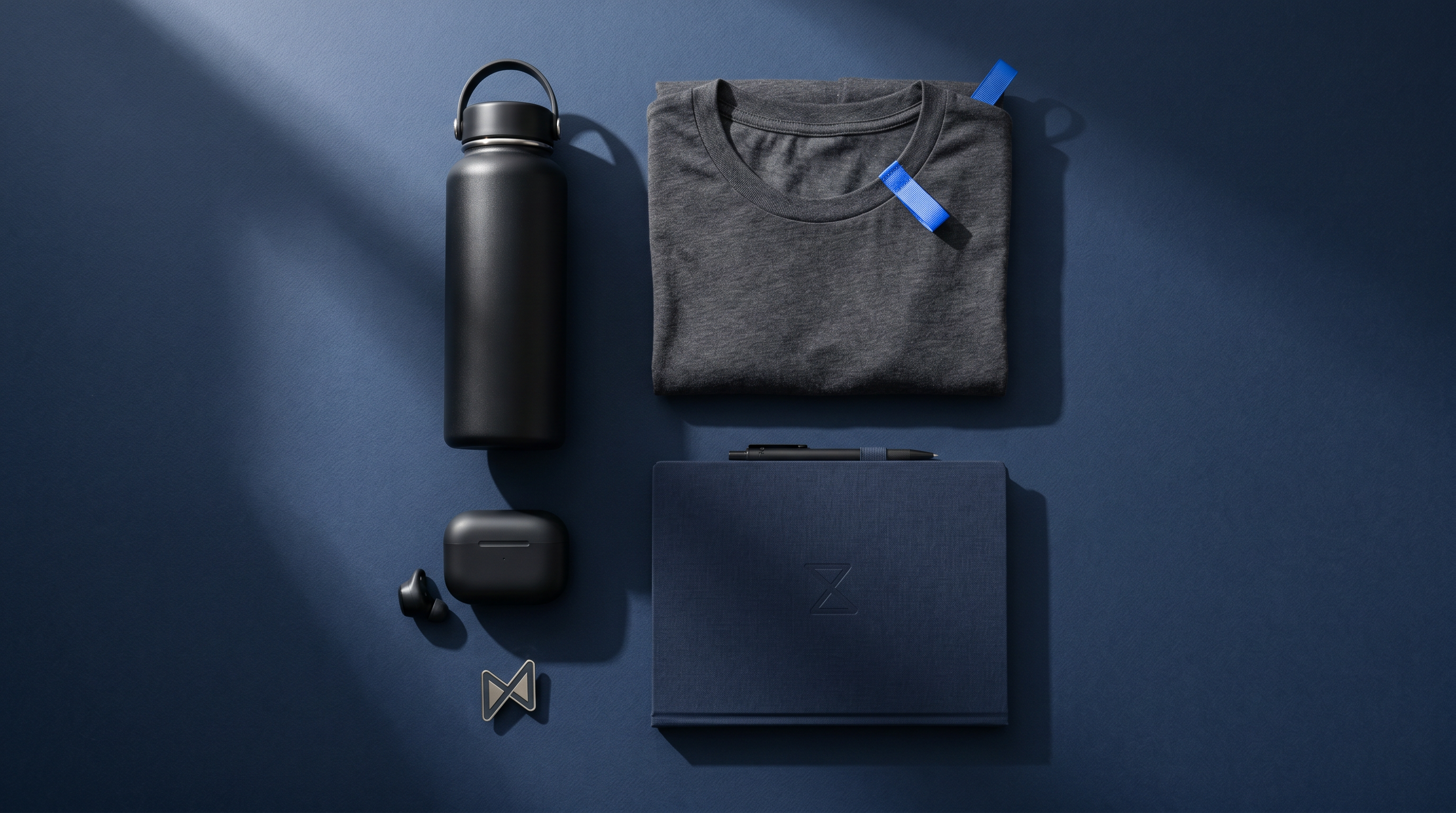
Forty percent of corporate gifts end up in the trash immediately. Not because the budget was wrong — because the gift felt like a budget decision, not a person decision. These 15 picks are the ones that get kept, photographed, and mentioned in the thank-you email your sales team actually receives.
- Gifts that feel personal get kept. Gifts that look promotional get tossed — regardless of price.
- The quiet branding principle: no logo on the exterior, or a small tonal emboss. Perceived value goes up when the billboard goes away.
- Government, pharma, and financial services clients often have $25 or $50 gift limits per person per year — always check before you send.
- Personalized gifts are 2.5x more likely to be kept than generic alternatives.
- Timing matters as much as the gift itself: post-renewal, post-milestone, and post-difficult-conversation are the three highest-ROI sending moments.
The under-$100 framework
Run every gift candidate through three fast tests — the dinner test, the keep test, and the specificity test — before you open a catalog.
Before you open a catalog, run every gift candidate through this three-part test. It takes 30 seconds and eliminates 80% of bad decisions.
“The gifts that get a reply are always the ones where the person can tell we actually thought about them. It has never been about the price point.”
One more structural note: segment your list by account tier before you start. The table below sets the ranges — and the rule that matters most is the warning underneath it.
| Tier | Gift range | Notes |
|---|---|---|
| Tier 1 accounts | $60–100 | Top 10–20% of revenue or highest pipeline potential. |
| Tier 2 accounts | $25–60 | Solid relationships worth a considered, personal gift. |
| Tier 3 accounts | $15–25 | A thank-you email with a small token at best. |
Do not mix tiers — sending a $20 gift to a $500k ARR account is worse than sending nothing, because it signals that you do not know what you have.
The 15 picks
Fifteen gifts under $100 that pass all three tests — kept, used, and personal enough to earn a reply.

1. A hand-thrown stoneware mug
Not a logo mug, and not a mass-produced ceramic. A genuine handmade mug from a small-batch pottery studio — the kind that has a slight variation in glaze because it was made by a person, not a machine. These run $28–55 and feel like a considered choice, not a catalog pick.
Pair with a small bag of single-origin coffee or a selection of loose-leaf teas for a $15–20 addition that makes the gift feel complete.
Who it works for: any client who you know has a morning ritual. It works especially well for founders and executives who are often alone at their desks early — the gift fits that moment.
Skip the logo. A small card with a note referencing a shared conversation is worth more than any branding.
2. A weighted linen eye mask and sleep kit
Sleep is the one luxury every busy executive claims they do not get enough of. A quality linen eye mask ($22–35), a small bottle of magnesium glycinate spray or a sleep-support supplement, and a brief personal note about slowing down lands differently than anything office-related. It signals that you are thinking about the person, not the work.
This gift category has grown substantially in the wellness-forward gifting segment. It clears compliance thresholds at most organizations (under $25 per item if sent as a single item, or under $50 for the kit) and has near-zero “throw away” rate because it addresses a genuine pain point.
3. A premium hardcover journal with lay-flat binding
The category staple — but quality matters enormously. The difference between a $7 spiral notebook and a $38 lay-flat hardcover with acid-free paper and a cloth cover is the difference between something used in a meeting and something left in a drawer.
Look for journals with a ribbon bookmark, a back pocket, and a paper weight that does not bleed through with a good fountain pen.
Personalize with a debossed initial on the front cover (no logo, no company name) or a printed dedication page inside the front cover with a handwritten-style note referencing the year or a goal. This is a Tier 1 or Tier 2 gift at $35–55.
4. An insulated glass water bottle
The stainless steel tumbler has been the default for three years — it is starting to feel expected. The current step-up is borosilicate glass with a silicone sleeve and stainless steel lid: it keeps beverages cold for 12 hours, feels substantial in the hand, and looks noticeably different from the standard insulated bottle. Price range: $35–65.
A small tonal logo on the silicone sleeve is acceptable here because the item is genuinely premium. This is one of the few gifting contexts where light branding does not diminish perceived value — the quality of the vessel does the work.
5. A single-origin coffee subscription (one month)
A one-month subscription from a specialty roaster, sent as a digital gift code, gives the recipient the experience of choosing their own roast and origin — which is itself a form of personalization. These run $22–45 for a 250g–350g shipment and are universally appreciated by the 64% of U.S. adults who drink coffee daily.
For the tea-focused recipient, the equivalent is a curated tea sample set from a small-batch blender.
This gift works best when paired with a note that references something specific: “I know your team has been heads-down on the Q2 close — thought you could use a good morning.” The coffee is the delivery mechanism for the sentiment.

6. A city-specific artisan food box
Source from a small producer in the recipient's city or region — a local hot sauce, a regional caramel, a jar of locally harvested honey. This is the highest-specificity move in the under-$100 range because it says: I know where you are, and I thought about that. Curated city boxes run $35–85 depending on the region and what you include.
The compliance note: food gifts are generally permissible at most organizations, but check your recipient's industry (see the compliance section below). Government and pharma contacts often have stricter rules on consumables. For finance and legal contacts, confirm the per-item value stays under their policy threshold before you ship.
7. A quality candle from a small-batch maker
Not a branded candle. A genuine, well-reviewed candle from a small-batch producer — the kind that lists the fragrance notes and the burn time on the label because the maker is proud of the product. Price range: $28–55 for 8–12 oz. This works across almost every recipient profile because it is personal (going into their home) without being presumptuous.
Fragrance guidance: stick to clean, universally appealing scents (cedar, light florals, sandalwood, citrus). Avoid anything pungent or niche (heavy oud, strong vanilla, anything described as “gourmand”). When in doubt, choose an unscented or lightly scented option.
8. A portable, packable rain jacket
A packable rain jacket from a quality outdoor brand — one that compresses into its own pocket and weighs under 200 grams — is the gift that gets used every time it rains. This is a Tier 1 gift at $65–95.
It requires knowing the recipient's approximate size (or using a redeem link so they can select their own), but the payoff is a garment that gets worn regularly in the real world, generating brand impressions with the logo that should be placed modestly on the chest pocket.
9. A Bluetooth desk speaker
A compact, high-fidelity desk speaker at $55–90 is a practical gift that fills a gap in most home offices — and it gets used daily. Look for models with a fabric exterior rather than plastic, USB-C charging, and a compact form factor. This is a Tier 1 gift for technical buyers and executives who work from home.
Do not have your logo printed on the speaker. A small branded tag or care card in the packaging is sufficient. The product itself should feel like a quality consumer purchase, not a promotional item.
10. A beeswax wrap and kitchen kit
For the sustainability-conscious client — and increasingly, that means most clients — a kitchen kit built around sustainable materials is a gift that tells a story about your values as well as theirs.
A set of beeswax food wraps, a bamboo utensil, and a reusable produce bag runs $30–50 and photographs well, which matters if you are tracking social media mentions of your gifting program.

11. A noise-canceling earbud case (charging accessory)
Not the earbuds themselves — those are too personal and too variable in preference. But a premium wireless charging case, an earbud cleaning kit, or a slim carry pouch for their existing earbuds at $25–55 is the kind of thoughtful accessory that solves a real problem without overstepping.
It says: I noticed you wear earbuds all day. That level of observation is what makes a gift feel considered.
12. A curated book, signed and shipped
A specific book, chosen because it relates to a conversation you actually had, with a brief handwritten note on the inside cover. This is the highest-specificity gift in this list and the one most likely to be mentioned in a follow-up email.
The price is entirely under your control — a $22 hardcover with a meaningful note outperforms a $90 gift basket with no connection to the person.
Rules: Do not choose a book about your industry or your product category. Choose something related to their stated interests, a podcast they mentioned, or a challenge they named. Business books are fine; self-help books require a closer relationship.
13. A premium desk mat
A large-format desk mat in a quality material — cork, leather, or a woven surface — is permanently visible in every video call and photo from the recipient's home office. At $40–85, it is a Tier 1 or Tier 2 gift that doubles as passive brand exposure every time the person appears on camera.
A subtle debossed logo in the corner is acceptable; anything larger defeats the purpose.
14. A locally made hot sauce or condiment set
Three to five bottles of genuinely interesting hot sauce or artisan condiments — sourced locally, labeled with the maker's story — is a Tier 2 gift at $30–55 that works across almost every recipient demographic. It is fun, specific, and immediately usable.
Pair with a hand-written card that references something about their personality (“I remember you mentioned you put hot sauce on everything”) and the specificity test is passed.
15. A guided mindfulness or meditation app subscription (one year)
A one-year subscription to a quality guided meditation app — delivered as a digital gift card — runs $55–70 and is genuinely valued by recipients who are overwhelmed but not sure how to fix it.
This is an unusual gift for a B2B context, which is exactly why it works: it is memorable, it signals real care, and it has a usage rate far higher than any physical item.
Best sent to clients you know well, with a note that acknowledges the pace of their year without being presumptuous.
What to avoid
Five categories quietly burn gifting budget without building any goodwill — cut them first.

The avoid list is as important as the gift list. These are the categories that consume budget without generating any of the goodwill you are trying to build.
- Branded merchandise masquerading as gifts. A tote bag with your logo on it is marketing collateral, not a gift. Your client knows the difference. If the primary purpose of the item is to promote your brand rather than to delight the recipient, it belongs in your booth budget, not your gifting budget.
- Gift cards to major retailers without a note. A $50 Amazon gift card is a budget allocation, not a gift. It says: “We had $50 to spend and no idea what you would want.” If you genuinely do not know the person well enough to pick a gift, use a personalized gifting quiz to match a curated selection to their profile, rather than defaulting to the department store approach.
- Anything with the person's name spelled wrong. Personalization is the point. Getting it wrong is worse than not personalizing at all. Verify the spelling in the CRM before you order, especially for names that have multiple common spellings.
- Perishables with long shipping times. Sending food items via ground shipping in summer, or to regions with unreliable delivery windows, risks arrival in poor condition. Either ship perishables overnight or substitute with a non-perishable alternative.
- Anything with a strong subjective preference requirement. Perfume, cologne, strongly scented personal care products, and items with high aesthetic preference (art prints, statement home decor) require a level of knowledge about the recipient that most business relationships do not support. Default to useful and neutral over beautiful and risky.
Personalization without logos
Debossed initials, a handwritten note, an insert card, and local sourcing beat a large logo every time.

The quiet branding principle holds: subtle personalization increases perceived value more reliably than a large logo. Here is what to do instead of plastering your company name on the item.
Debossed initials
On leather goods, journals, and desk accessories, a debossed initial on the cover costs $2–5 per unit and transforms a generic item into something the recipient feels is theirs. This is more valuable than your logo because it makes the item harder to re-gift and more likely to become a regular part of their routine.
A handwritten note
Or a high-quality printed note that looks handwritten. This does more personalization work than any product decoration. Reference something specific: a call they mentioned, a result they achieved, a challenge they named. Three sentences is enough. Signature from a real person, not “The [Company Name] Team.”
A custom insert card
A printed card inside the packaging — not on the box, inside it — that tells a brief story about why you chose this specific item for this specific person. “We chose this journal because you mentioned you start every morning writing before you open email. We hope it's a good companion.”
This costs cents to produce and converts a product into a story.
City or region sourcing
Sourcing the gift from the recipient's city — a local roaster, a regional pottery studio, a neighborhood food producer — is the highest-specificity move available without needing personal information beyond their location. It signals research. It signals care. And it supports local makers, which is a values alignment that increasingly matters to the people you are trying to impress.
Compliance and gift policies
Know the IRS, government, pharma, financial, and international thresholds before you send — and check the recipient's own policy.

Gift compliance is the part of client gifting that most teams skip until they cause a problem. Here are the rules you need to know before you send.
IRS gift deductibility
Business gifts to clients are deductible at $25 per recipient per year under IRS rules. This does not mean you cannot send more — it means you can only deduct $25 of the cost. Gifts above $25 are still common and legal; they just require the excess to come from after-tax business funds. Consult your tax advisor for your specific situation.
Government and public sector contacts
Federal employees are generally prohibited from accepting gifts valued at more than $20 per occasion and no more than $50 per year from a single source. State and local rules vary but are often similar.
If you are gifting to any government agency contact — at the federal, state, or municipal level — the $20 rule is the safe ceiling. When in doubt, a handwritten note and a $15 locally sourced item is sufficient and compliant.
Pharmaceutical and healthcare contacts
The PhRMA Code limits gifts to healthcare professionals to items of minimal value (generally interpreted as under $10–15) that primarily benefit patients or serve a clear educational purpose. In practice, this means most of the gifts on this list are off the table for HCP contacts.
Consult your compliance team if you sell into pharma or healthcare. A branded notepad and a $5 coffee gift card may be the practical ceiling.
Financial services contacts
FINRA Rule 3220 limits gifts to clients and prospects to $100 per person per year. This rule applies to broker-dealers and their associated persons. The good news: most of this list falls under $100 per item. The risk: if you are sending multiple gifts to the same person in a year, track the cumulative total carefully.
International recipients
The UK Bribery Act 2010, the U.S. Foreign Corrupt Practices Act, and equivalent legislation in the EU impose significant restrictions on gifts to foreign officials and, in some interpretations, commercial relationships. If you are gifting to contacts outside the U.S., check the applicable rules for their jurisdiction and have your legal team sign off on the program design.
FAQ
Quick answers to the questions teams ask most when choosing corporate gifts under $100.
What are good corporate gifts under $100?
The best under-$100 corporate gifts are useful, durable, and feel personal rather than promotional.
The picks on this list — hand-thrown mugs, premium journals, insulated glass bottles, city-sourced food items, quality candles — all clear the three-part test: the dinner test (would you hand it across a restaurant table?), the keep test (will it have a home in their life in 90 days?), and the specificity test (does it reference something about the recipient?).
Start with those three filters and you will eliminate most bad decisions before they happen.
How do you make a budget gift feel premium?
Three things: packaging, personalization, and timing. A $30 item presented in thoughtful packaging with a genuinely personal note, sent at the right moment (after a renewal, after a difficult conversation, after a big milestone), will consistently outperform a $90 item sent generically at the end of the year.
The note is often worth more than the gift itself. Write three specific sentences — not a template — and sign with your actual name.
What is the difference between a gift and promotional swag?
The primary purpose test. Swag's primary purpose is to promote your brand. A gift's primary purpose is to delight a specific person. The physical difference is often a logo — swag has your name on it, a gift usually does not, or has it only minimally.
The experiential difference is even clearer: swag feels like it was sent to your job title, a gift feels like it was sent to you.
Are there IRS rules on client gifts?
Yes. Business gifts to clients are deductible up to $25 per person per year under IRS Section 274(b). Gifts above that threshold are still permissible — they are just not deductible for the excess. There are additional rules for gifts that are also entertainment, and for gifts to employees vs. clients. Consult a qualified tax advisor for your program specifics.
How do I personalize a gift for a client I do not know well?
Use what you do know. Their location (city-sourced items), their role (a book relevant to their function), their recent milestone (a congratulations gift tied to a specific achievement), or their stated preferences from past conversations. If you genuinely have nothing to go on, a gifting quiz or AI recommendation tool can narrow a curated shortlist from basic parameters (industry, seniority, occasion).
The worst answer is a generic catalog pick — if you have no information, a handwritten note with a digital gift code for a curated store is more honest than a pretend-personalized item.
Jenna runs our client gifting advisory and heads sustainable sourcing. Before ActivateSwag, she led procurement for a B Corp-certified apparel label.
A short, useful email every other Thursday.
Operational playbooks for swag and gifting — read in two minutes. No spam, no filler.