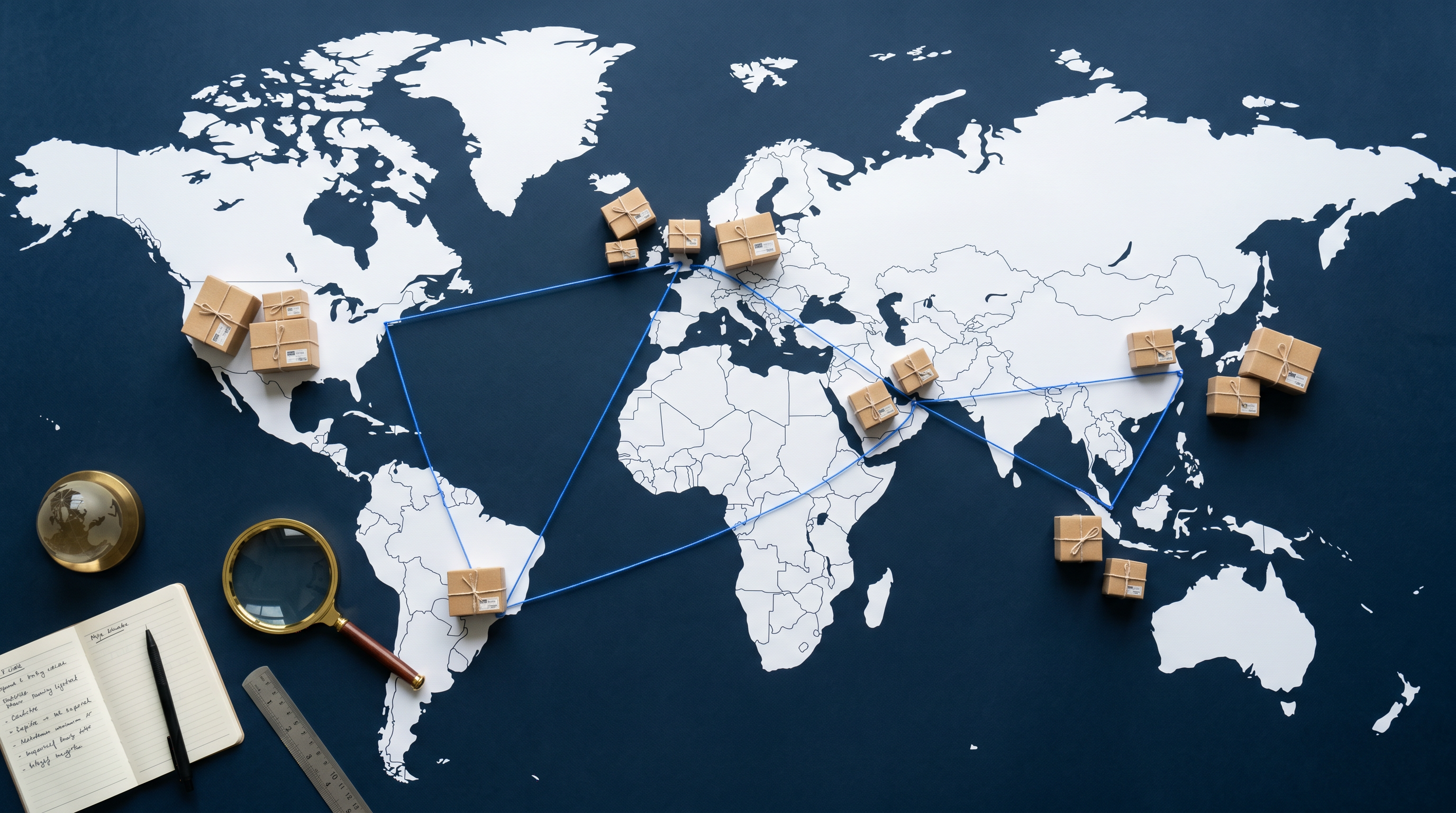
Shipping swag internationally is not hard — until it is. One missing field on a commercial invoice, one wrong HS code, one package addressed to an EU recipient without IOSS registration, and your carefully planned gift campaign turns into a three-week customs hold. Here's how to stop that from happening.
- Four documents move every international box: commercial invoice, packing list, airway bill, and (sometimes) certificate of origin. Missing or wrong fields on any one of them causes holds.
- The EU's €150 customs duty exemption is being removed — all parcels shipped to EU destinations will require customs duties and VAT clearance, regardless of value.
- IOSS registration lets you pre-collect EU VAT at checkout and clear customs instantly — without it, EU recipients face surprise charges and 25%+ delivery refusal rates.
- Regional warehousing dramatically reduces duty exposure, transit time, and last-mile failure rates. It's why we stopped shipping hoodies trans-Atlantic.
- Landed cost = product cost + freight + import duty + VAT/GST + last-mile. Build it into your budget before the PO, not after the invoice arrives.
The cross-border problem
Single-origin shipping breaks on transit time, customs clearance, and recipient experience — a layered fix beats any single solution.
Most corporate swag programs start domestic and go global by accident. A new hire in Amsterdam. A client in Singapore. A remote team in Brazil. Each one triggers a question nobody planned for: how do we get this box there without a nightmare?
The naive answer — "just ship from our U.S. warehouse" — breaks in three predictable ways.
- First, transit time. Air freight from the U.S. to Southeast Asia runs 5–10 business days at best, and your $40 hoodie might attract $15 in import duties the recipient didn't expect.
- Second, customs clearance. A commercial invoice with a missing field, an incorrect HS code, or a declared value that doesn't match the actual product value triggers a hold — sometimes for weeks.
- Third, recipient experience. A package that arrives with a "duties owed" slip at the door turns your goodwill gesture into an unpleasant billing surprise. In the EU, recipients refuse those packages at a rate approaching 25%.
The fix is not a single solution. It's a layered approach: the right documents, the right compliance registrations (especially EU IOSS), regional warehousing where volume justifies it, and a cost model that accounts for landed cost — not just the price on your purchase order.
The regional warehouse model
Stocking recurring items regionally eliminates import duty and international freight — turning an $80–90 landed hoodie back into a domestic delivery.
The most effective change we made to our international fulfillment network was stopping trans-Atlantic and trans-Pacific shipments for recurring items. Here's the logic.
A hoodie shipped from our U.S. fulfillment center to a recipient in the UK incurs: DHL or FedEx international air freight (~$18–25 for a 1kg package), UK import duty on clothing (12%), UK VAT (20%), and DHL's brokerage fee (~£10–15).
The regional model works differently. Stock the hoodie in a UK or European warehouse (decorated locally or pre-decorated at origin). When a recipient in Frankfurt redeems their gift, the item ships domestically from Frankfurt — no import duty, no international freight, and next-day or two-day delivery.
The trade-off is that you need sufficient volume to justify regional stock, and you need to pre-decorate before regional stocking (which means committing to artwork before orders are placed).
When regional warehousing makes sense
- You have 50+ annual sends to a specific region (EU, APAC, LATAM)
- You're running a time-sensitive campaign (new hire kits, event swag) where transit variance is unacceptable
- The product category carries high import duties in the destination region (apparel in the EU: 12%; shoes: 8–17%)
- Recipients are consumers or employees, not corporate receiving docks that can manage duty invoices
When single-origin shipping works fine
- Volume is low (fewer than 20 sends per quarter to a region)
- The recipient is a corporate address with a dedicated receiving team that handles customs clearance
- The product value is high enough that duties are a small percentage of total cost, and the recipient expects them
- You're shipping DDP (Delivery Duty Paid) and absorbing the duty cost into your program budget
The four documents that move a box
Customs cross-checks the commercial invoice, packing list, airway bill, and certificate of origin — any mismatch triggers a hold.

Every international shipment requires four core documents. Customs authorities compare them against each other — discrepancies trigger holds. Here's what each one is, and the fields that trip people up most often.
| Document | What it is | Critical fields | Common error |
|---|---|---|---|
| Commercial Invoice | The official record of the sale — used by customs to determine duties | Seller/buyer name and address, itemized description, quantity, unit price, total value, currency, country of origin, HS code, incoterm (DDP or DDU) | Declared value doesn't match actual transaction value, or 'gift' notation used to undervalue (illegal) |
| Packing List | Physical description of package contents | Item count, dimensions, weight (gross and net), package count, reference to commercial invoice | Quantities don't match commercial invoice; missing net vs. gross weight distinction |
| Airway Bill (AWB) / Bill of Lading | Carrier's receipt and contract of carriage | Shipper/consignee, origin/destination airport or port, piece count, chargeable weight, special handling instructions | Consignee address incomplete or mismatched vs. invoice; missing phone number for customs contact |
| Certificate of Origin (CoO) | Confirms where goods were manufactured — required for preferential duty rates | Country of manufacture (not country of purchase), HS code, exporter signature, sometimes Chamber of Commerce stamp | Listing country of purchase vs. country of manufacture; required for US-origin goods claiming preference under trade agreements |
Two practical rules. First, always ship DDP (Delivery Duty Paid) for recipient-facing programs. DDU (Delivery Duty Unpaid) means the recipient pays customs and a brokerage handling fee at the door — a bad experience that turns your gift into a bill.
Second, never undervalue a commercial invoice to avoid duties. Customs fraud is a criminal offense in every jurisdiction, and most carriers have fraud detection that flags repeated low-value declarations for high-value items.
EU IOSS and the €150 threshold
IOSS pre-collects EU VAT so packages clear customs electronically — the difference between smooth delivery and a 25% refusal rate.
If you send swag to anyone in the EU, IOSS (Import One-Stop Shop) is not optional — it's the difference between smooth delivery and a 25% refusal rate.
How IOSS works
IOSS is an EU VAT simplification scheme introduced in July 2021. Here's the mechanism in plain terms:
- Your platform or fulfillment provider registers for an IOSS number (through an EU-based fiscal intermediary if you're a non-EU entity).
- When a shipment is generated for an EU destination, the applicable VAT is calculated at point of sale and collected up front.
- The IOSS number is printed on the commercial invoice and airway bill. EU customs authorities see the IOSS declaration and can clear the package electronically — without stopping it for manual assessment.
- The VAT collected is remitted monthly to the EU tax authority via the IOSS portal.
The result: your EU recipients receive their packages without brokerage fees, without customs holds, and without surprise invoices.
For non-EU companies, IOSS registration requires an EU fiscal intermediary (a licensed tax representative in an EU member state). This is a one-time setup. Most enterprise fulfillment providers either hold their own IOSS number or can facilitate registration. If your current swag platform cannot confirm IOSS registration, that's a gap worth addressing before your next EU send.
Country-specific rules
Brazil, India, the UK, Canada, Australia, and Japan each carry distinct requirements that ambush first-time international shippers.

Beyond EU IOSS, a handful of markets have distinct requirements that catch first-time international shippers off guard.
| Country / Region | Key requirement | Threshold / Rate | What to do |
|---|---|---|---|
| Brazil | SISCOMEX import declaration; high duty rates | Import duty 60%+ on apparel; II + IPI + ICMS taxes stacked | Use local production or regional warehouse in São Paulo; shipping from the U.S. to individual recipients in Brazil is rarely cost-effective |
| India | HSN code required on all commercial invoices; IGST applies | Apparel import duty 20%+; textiles HSN 61/62 | Require your fulfillment partner to correctly classify items; underclassification triggers holds at Mumbai/Delhi customs |
| UK (post-Brexit) | UK VAT applies to all shipments; EORI number required | UK VAT 20%; import duty on textiles 12%; de minimis £135 | Collect UK VAT at checkout; ship DDP; UK EORI number required for exporter |
| Canada | CARM (CBSA Assessment and Revenue Management) platform | CUSMA/USMCA preference for U.S.-origin goods; textiles duty otherwise 18% | Confirm U.S. origin and claim CUSMA preference on commercial invoice; include country of origin cert if required |
| Australia | GST on imports; ATO registration required for non-resident sellers over A$75K threshold | GST 10% on all imports since 2018; Customs Duty on textiles 10% | Register for Australian GST if annual sends exceed A$75K; otherwise recipient pays GST at clearance |
| Japan | Strict labeling requirements; country of origin must appear on all apparel | Import duty on apparel 10–16% | Ensure apparel carries a Japanese-language care label and country of origin label; missing labels = customs hold |
“Brazil is where swag programs go to die. We've seen a single shipment to five recipients in São Paulo cost more in duties and brokerage than the product itself. Regional production is the only answer for any volume above a handful of sends per year.”
Cost model that works
Budget on landed cost, not the purchase order — and stock regionally once a region clears 40 sends in a year.

The single biggest budgeting error in global swag programs is pricing off the purchase order. The number that matters is landed cost — what it actually costs to put the item in the recipient's hands, including all taxes, freight, and fees.
The landed cost formula
Landed cost = Product cost + International freight + Import duty + VAT/GST + Last-mile delivery + Brokerage fee (if DDU)
Here's a worked example: a $40 branded hoodie shipped from a U.S. warehouse to a recipient in Germany.
| Cost component | Amount | Notes |
|---|---|---|
| Product cost (hoodie) | $40.00 | U.S. wholesale price |
| International air freight (DHL, ~1.2kg) | $22.00 | U.S. to Germany, economy express |
| EU import duty (textile rate 12%) | $4.80 | 12% of product value |
| German VAT (19%) | $12.54 | 19% of (product + freight + duty) |
| DHL brokerage fee | $0.00 | Included in DDP rate if using DHL Express DDP |
| Total landed cost | $79.34 | vs. $40 on the PO — nearly 2× |
That same hoodie, shipped from a UK/EU regional warehouse, costs approximately: £28 product (pre-decorated), £4.50 domestic last-mile delivery, £0 import duty, £0 VAT collected at point of sale via IOSS or UK VAT registration. Total: ~£32.50 (~$41). That's less than half the landed cost of the trans-Atlantic route.
The regional model requires upfront investment in regional inventory, but the per-unit economics justify it at modest volumes. Our rule of thumb: if you expect more than 40 sends to a region in a 12-month period, regional stocking pays for itself.
Pre-shipment checklist
Run this before every international batch.
- Commercial invoice completed: itemized description, quantity, unit value, total value, currency, HS code, country of origin, incoterm (DDP), and both seller and buyer contact details.
- Packing list matches commercial invoice quantities exactly.
- HS code verified against the destination country's tariff schedule — not just assumed from U.S. HTS code (they differ).
- IOSS number printed on airway bill for all EU destinations.
- DDP selected as the incoterm — recipient should not receive a duty invoice.
- Declared value matches actual transaction value — no gift undervaluation.
- Country of origin documented (certificate of origin if required for preferential rates).
- Recipient address includes full postal code, phone number, and email — incomplete addresses are the #1 cause of last-mile failure.
- Brazil, India, or Japan shipments reviewed by a licensed customs broker before dispatch.
- Tracking numbers sent to recipients with estimated delivery window — reduces 'where is my package' inquiries by 60%+.
FAQ
Quick answers to the questions teams ask most when shipping swag across borders.
What is IOSS and do I need it for EU shipments?
IOSS (Import One-Stop Shop) is an EU VAT collection scheme that lets sellers remit VAT centrally rather than at each EU customs point. Without IOSS, your EU-destined packages get held at customs for manual VAT assessment, the recipient receives a duty notice, and roughly 25% refuse delivery.
If your platform ships to EU recipients, IOSS registration is effectively mandatory for a reliable delivery experience. Non-EU companies need an EU fiscal intermediary to register — most enterprise fulfillment providers handle this as part of their service.
What happened to the EU's €150 duty exemption?
The EU reached political agreement in November 2025 to remove the €150 customs duty exemption threshold. This was the rule that let low-value parcels enter the EU without import duty.
Under the new framework (being phased in 2026–2028), all EU imports will be subject to customs duties regardless of value. Combined with IOSS (which handles VAT), this means the commercial invoice and accurate HS code classification matter for every single EU shipment, regardless of how small.
What's the difference between DDP and DDU?
DDP (Delivery Duty Paid) means you, the shipper, are responsible for paying all import duties and taxes before delivery. The recipient receives the package with no additional charges due. DDU (Delivery Duty Unpaid) means the recipient pays customs duties upon delivery — often with an added brokerage handling fee from the carrier.
For any recipient-facing swag program, you should always ship DDP. DDU turns your goodwill gesture into a surprise bill, and recipients frequently refuse delivery, which means you pay return freight on top of everything else.
How do I figure out the right HS code for swag items?
HS codes are the international product classification system used by customs authorities worldwide. The first 6 digits are standardized globally; digits 7–10 vary by country.
For common swag categories: knit cotton T-shirts are 6109.10, woven cotton bags are 4202.92, insulated stainless steel bottles are 7323.93, and uncoated paper notebooks are 4820.10. Verify the destination-country tariff schedule (the U.S. HTS and EU CN codes diverge at the 8-digit level).
Misclassification is the leading cause of customs holds on apparel — if you're unsure, a licensed customs broker can classify a product for $50–100, which is cheap compared to a two-week hold.
Can I ship swag to Brazil without a customs nightmare?
To individual recipients at home addresses: probably not cost-effectively. Brazil's SISCOMEX import system, stacked import taxes (II + IPI + ICMS), and high inspection rates make individual-address shipments from outside Brazil prohibitively expensive for standard swag.
The effective import duty on apparel is 60%+, and individual packages frequently attract additional brokerage and storage fees at clearance. For any meaningful Brazil program, local production or regional warehousing with a Brazil-based 3PL is the practical answer. We can connect you with our Brazil fulfillment partners through the fulfillment platform.
Daniel runs our warehouse and international fulfillment network. He has spent 12 years in cross-border logistics, previously at a Fortune 500 3PL.
A short, useful email every other Thursday.
Operational playbooks for swag and gifting — read in two minutes. No spam, no filler.